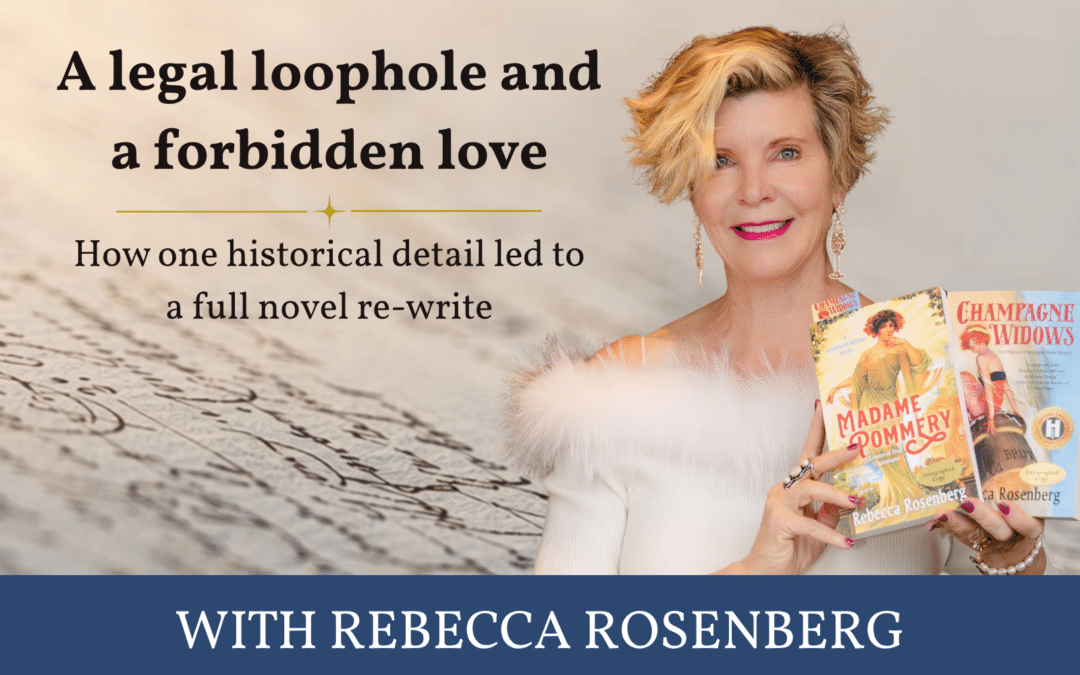
For a historical fiction writer, a single overlooked detail can unravel years of careful planning. In our inaugural author interview blog, historical novelist Rebecca Rosenberg reveals how a single unexpected discovery on a mansion tour led to a complete rewrite of her novel. Want to be interviewed for our blog? Join our author interview network.
From wine country to historical fiction
I write historical biographical fiction – eight novels so far – to find the untold stories of extraordinary women forgotten or oversimplified by history.
Living in California’s Sonoma wine country, sparkling wine has always been my favorite. I have spent over a decade studying the traditional champagne method, leading specialized tours, and presenting on the region's history.
My champagne novels began as a multi-year research project into the "Champagne Widows" – legendary women who built the modern champagne industry. I wanted to understand how they conquered a highly competitive, male-dominated trade long before women even had the right to vote.
The Breakthrough Discovery
My perspective shifted when I aligned the staggering number of 19th-century French military casualties with the strict laws of the era.
Through decades of conflict, France’s male population was repeatedly depleted:
- French Revolution & Civil Wars: ~550,000 to 750,000 deaths
- Napoleonic Wars: ~800,000 to 1,000,000 deaths
- World War I: ~1,440,000 deaths
- World War II: ~600,000 deaths
With so many men dying or away at war, women were left running vineyards and businesses by default. Yet, under the Napoleonic Code of 1804, a married woman was legally a minor under her husband’s absolute authority. She couldn't sign contracts, open bank accounts, or run a business without his written consent, and he legally controlled all of her assets.
The discovery that changed everything for me was The Widow (Veuve) Exception.
Upon a husband’s death, a French widow escaped this legal control. She suddenly gained full financial independence, inherited the estate, and took sole control of the business. This unique legal loophole allowed famous figures like Widow Clicquot, Madame Pommery, and Lily Bollinger to build their champagne empires. Their widowhood was the exact legal key that allowed them to exist as independent business owners.
Uncovering Madame Pommery
I set out to write Madame Pommery's specific story, focusing on her grit and ingenuity. She took over a struggling wool and wine business in Reims in 1860, and I spent years researching how she engineered the world's first dry "Brut" champagne.
Already have an account? Log in here.
Rebecca Rosenberg is a triple-gold award-winning historical novelist, champagne historian, and professional storyteller. A graduate of the Stanford University novel-writing program, she has spent more than a decade researching the history and craft of French sparkling wine. She is the author of the Champagne Widows Trilogy, Women of Fate & Fortune Trilogy, and Lavender Fields of America. Her upcoming novel is Saving Liberty: Peter Max and his Five Muses. Connect with Rebecca on her website, Instagram, and Facebook.