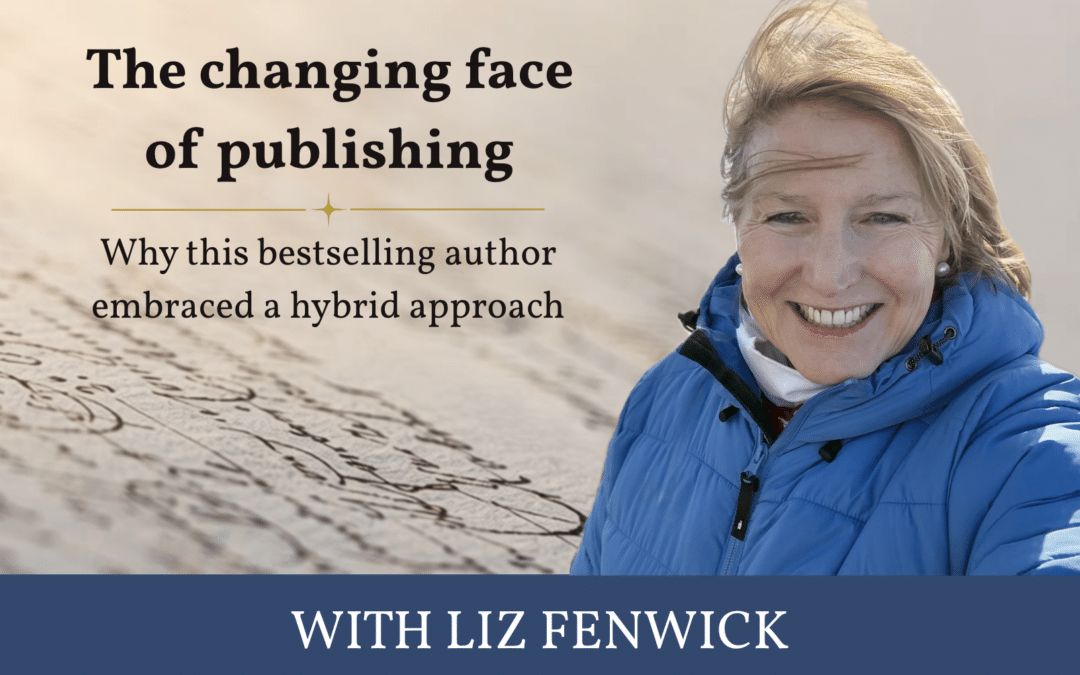
In this week’s blog, bestselling author Liz Fenwick reflects on the changing realities of the publishing world. Drawing on her journey as a writer from traditional publishing to self-publishing, she shares the decisions that shaped her career and the lessons she learned along the way. Want to be interviewed for our blog? Join our author interview network.
How it all began
I had always wanted to be a writer, but like so many of us, I put my dreams of writing aside to earn a living. It wasn’t until 2004, when I was in my forties, that I resurrected those dreams.
In 2011, I finally signed with my dream agent, Carole Blake. Her representation was hard won – I wrote a new novel almost every year during those seven years. In 2012, my debut novel, The Cornish House, was published by Orion in the UK, and garnered several foreign deals. A further nine novels followed, with a change of publisher along the way – this time an imprint of another Big Five publisher. I built up a loyal readership, who came with me on the journey from contemporary to historical fiction, and I carved out a successful niche for myself as an author of Cornwall-inspired historical fiction.
Then, in 2026, after publishing ten books, I made a momentous decision. I broke my contract and decided to self-publish.
The decision to leave traditional publishing
The book I broke my traditional publishing contract for was Flora’s Day. There were a number of reasons why I decided to break my contract and pay back the advance, but crucially, I felt this particular story wouldn’t be served by the traditional publishing route. My entire body of work had been positioned to carefully tick certain commercial boxes, and had I stayed with my publisher, every aspect of the book would have had to conform with that pre-determined direction. I would have had no say over the publication date, or cover design, or marketing strategy.
To give you some context, Flora Day, Helston’s traditional May Day festival, is celebrated on the eighth of May. The publishers wanted to publish a book celebrating the arrival of spring and summer in August – a whole three months after the festival itself. The timing of publication simply didn’t make sense. It worked for the publisher, but it didn’t work for my novel.
To conform with other books in my genre, the publishers also wanted the cover to feature a woman standing on a beach. This story, about the granite heart of Cornwall, did not need such a stereotypical cover. Again, it made no sense. There isn’t even a beach in Helston!
Though these factors tipped the balance in favour of self-publishing Flora’s Day, they weren’t the only considerations that made me take the plunge. The publishing landscape is a different place now to what it was when The Cornish House was published. Competition for traditional publishers’ time, and budget spend, has grown. The author–publisher relationship has changed considerably.
Changes in the traditional publishing world
When I was first traditionally published, you weren’t expected to be a best-selling author from the outset. The publisher wanted you to grow as a writer and bring you to the point of being a bestseller – you were seen as an investment, if you like.
Already have an account? Log in here.
Liz Fenwick, dubbed 'the queen of the Cornish contemporary novel' by The Guardian, is an award winning author of contemporary, dual timeline and historical fiction. Her lastest book is Flora’s Day: A Cornish Love Story. She lives in Cornwall with her husband and two mad cats. When not writing and reading she is plot walking and procrastinating on social media. To discover more or sign up for her newsletter, visit www.lizfenwick.com or @liz_fenwick on Instagram.