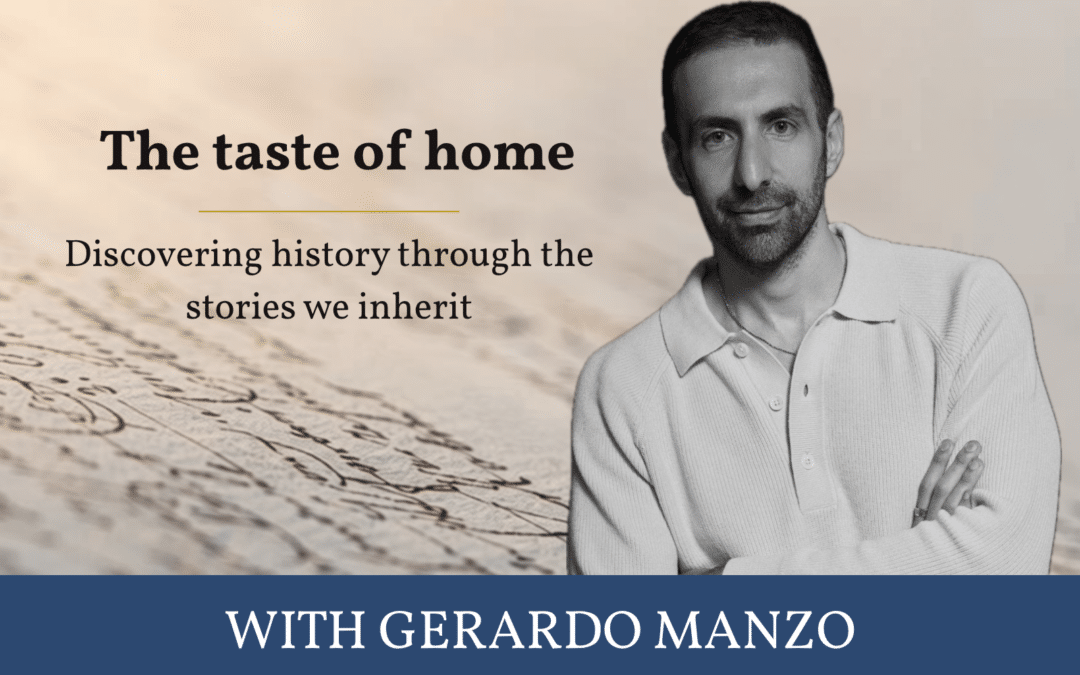
In this week’s blog, Gerardo Manzo traces a connection between a childhood memory and three centuries of Italian history. As he researches his roots and the world of Baroque Naples for his novel, Gerardo explores how distance can change our understanding of home, and why our most personal memories might be the most important stories to preserve.
Want to be interviewed for our blog? Join our author interview network.
A strange dessert
There was a ritual I watched as a child. A fight for sustenance, rooted in numbers tracing back centuries.
Sometimes I can still see him sitting at the head of the table, his thumb digging into a mandarin. I can still see the bright orange skin breaking, spraying a fine mist of citrus oil into the air. With one hand, he’d reach for a piece of bread, lay a mandarin wedge on top, and bite into it with what few teeth he had left.
Alfonso – Funzin’ – my grandfather – he must have been about seventy years old then. I can’t recall his exact age, but I remember his face clearly. He’d look down at me, not even a teenager yet, and murmur, “Want some dessert?” all while hissing a smile through his thick mustache.
That was his answer to my bewildered, what-are-you-doing-Grandpa? look. And, before taking his next bite, he’d go on telling not just a story, but his story.
Who would ever think that bread and citrus made for a dessert? But creativity took a different shape if you, like Funzin’, were born in the Italian South between two World Wars. This was the result of scarcity: desserts were simple, and for meals, meat was rarely an option. Luck placed it on the table maybe once a month, at most.
Three centuries of history come together
Centuries earlier, the math was strikingly similar. In early 1600s Naples – then the second-largest city in Europe – renting a basso (a windowless, one-room dwelling opening directly onto the street) cost around eleven ducats a year.
For a bank gatekeeper earning three ducats a month, the margin for survival was razor-thin. A single rotolo (~1kg) of veal cost roughly 0.3 ducats. Without getting lost in numbers and math, buying veal just once a week would mean spending over a third of his monthly salary on meat alone, guaranteeing bankruptcy overnight.
When I stumbled across those archival numbers, the three hundred years between Baroque Naples and my grandfather melted away.
Fundamentally, the situation in the South hadn't changed. I realized my grandfather’s ritual wasn't just a personal quirk: it was the continuation of a centuries-old instinct for survival and small joys. Suddenly, that piece of mandarin laid on stale bread didn't just look like a childhood memory. It was a gateway into generations of history.
Finding the past through my novel
I would never have discovered this connection if it weren’t for my writing. The novel I am developing is set in Baroque Naples during the early 1600s.
Already have an account? Log in here.
Gerardo Manzo was born in Naples, grew up among its streets, churches, and stories, and left in 2008 — first to Rome, then Chicago, then New York City, where he now lives. Distance, as it turns out, was what it took to truly see home. He holds a PhD and has a background in academic research, skills he now puts to work uncovering the hidden lives of Baroque Naples for his debut novel, The Sibyl, set in the early 1600s. He created The Historical Novelist to share what that research reveals. You can also follow his journey on Instagram or his website.